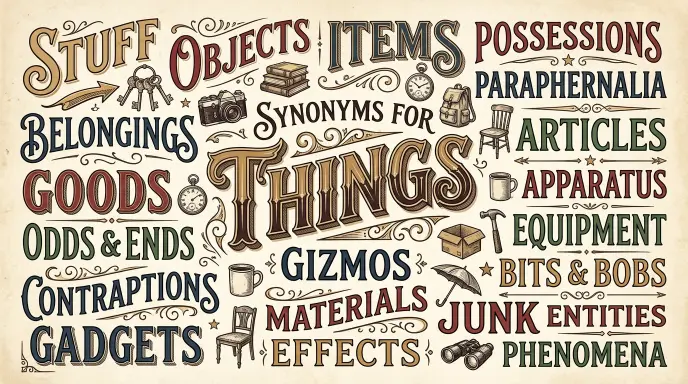
When you write or speak, do you often use the word “things” again and again? You are not alone. Synonyms for things can make your English sound clearer and more interesting. For example, instead of saying, “Put your things on the table,” you can say, “Put your belongings on the table.”
The meaning is almost the same, but the second sentence is more exact. Synonyms for things are useful when you want better word choices. Students can use them in essays and assignments. Bloggers and content writers can use them to avoid repeated words.
Daily English users can use them in simple conversations. Learning these words can help you choose the right word for each situation.
1. Objects
Meaning: Objects are physical things that you can see or touch.
Examples:
- The room had many old objects.
- Please move those objects from the floor.
2. Items
Meaning: Items are individual things that are listed, bought, or used.
Examples:
- I need three items from the store.
- She packed all the items in one bag.
3. Stuff
Meaning: Stuff means a group of things when you do not name each one.
Examples:
- I need to clean my stuff.
- Your stuff is still in the car.
4. Belongings
Meaning: Belongings are things that belong to a person.
Examples:
- He packed his belongings before leaving.
- Keep your belongings with you.
5. Possessions
Meaning: Possessions are things that a person owns.
Examples:
- She kept her most valuable possessions safe.
- His possessions were stored in a small box.
6. Goods
Meaning: Goods are things made or sold for people to buy.
Examples:
- The shop sells fresh goods.
- These goods arrived this morning.
7. Products
Meaning: Products are things made to be sold or used.
Examples:
- This company makes beauty products.
- I saw new products on the shelf.
8. Materials
Meaning: Materials are things used to make or build something.
Examples:
- We need more materials for the project.
- The teacher gave us art materials.
9. Objects
Meaning: Objects are separate physical things that can usually be seen or touched.
Examples:
- Several objects were on the desk.
- The museum displays ancient objects.
10. Articles
Meaning: Articles can mean physical items, especially in formal English.
Examples:
- The store sells household articles.
- Several articles were placed in the box.
11. Belongings
Meaning: Belongings are personal things that someone owns.
Examples:
- She left her belongings at school.
- Please take your belongings when you leave.
12. Possessions
Meaning: Possessions are personal items that someone owns.
Examples:
- He keeps his possessions in a locker.
- Her favorite possessions include old books.
13. Equipment
Meaning: Equipment means the tools and machines needed for a task.
Examples:
- The gym has modern equipment.
- We checked the equipment before the game.
14. Tools
Meaning: Tools are objects used to do a particular job.
Examples:
- Put the tools back after use.
- The mechanic bought new tools.
15. Devices
Meaning: Devices are objects made for a special purpose, often using technology.
Examples:
- Many students use digital devices.
- Turn off your devices before class.
16. Gadgets
Meaning: Gadgets are small devices that are useful or fun to use.
Examples:
- He loves buying new gadgets.
- This gadget makes cooking easier.
17. Resources
Meaning: Resources are useful things that help you do something.
Examples:
- The website offers free learning resources.
- We used online resources for the project.
18. Supplies
Meaning: Supplies are things needed for a particular activity or task.
Examples:
- We bought school supplies yesterday.
- The teacher checked our art supplies.
19. Components
Meaning: Components are separate parts that make up something larger.
Examples:
- The phone has many small components.
- Each component has an important job.
20. Parts
Meaning: Parts are pieces that belong to or make up something.
Examples:
- I need new parts for my bike.
- The machine has several moving parts.
21. Elements
Meaning: Elements are basic parts of something.
Examples:
- Color is an important element of the design.
- The story has several key elements.
22. Features
Meaning: Features are useful or noticeable parts of something.
Examples:
- This phone has many useful features.
- I like the safety features of this car.
23. Details
Meaning: Details are small pieces of information about something.
Examples:
- Please check the details before signing.
- She explained all the details clearly.
24. Matters
Meaning: Matters are subjects or situations that people talk or think about.
Examples:
- We need to discuss some important matters.
- Family matters should stay private.
25. Subjects
Meaning: Subjects are topics that people study, discuss, or write about.
Examples:
- We talked about several subjects today.
- Science is one of my favorite subjects.
26. Topics
Meaning: Topics are subjects that people talk or write about.
Examples:
- The teacher gave us three topics.
- We discussed interesting topics at lunch.
27. Issues
Meaning: Issues are problems or subjects that need attention.
Examples:
- We need to solve these issues soon.
- The meeting covered several important issues.
28. Aspects
Meaning: Aspects are particular parts of a subject or situation.
Examples:
- We studied different aspects of the story.
- Cost is one important aspect of the plan.
29. Affairs
Meaning: Affairs are events, activities, or matters connected to a person or group.
Examples:
- He keeps his personal affairs private.
- The manager handles the company’s affairs.
30. Entities
Meaning: Entities are separate things or units that exist.
Examples:
- The report names several business entities.
- Each entity has its own role.
Conclusion
Learning synonyms for things helps you choose better words for different situations. It can make your writing clearer and less repetitive.
These words are useful for essays, blogs, emails, and everyday conversations. Try using a new synonym each day. With regular practice, you can improve your vocabulary, writing, speaking, and communication skills. The key is to learn not only the meaning but also when each word sounds natural.

Jonathan writes simple, easy-to-understand English vocabulary guides, word meanings and synonyms at SimilGrid.