The word “shows” means to make something clear, let people see something, or explain an idea. Imagine writing an essay about climate change. You may write, “This example shows the effects of pollution.” The word works well, but using it many times can make your writing sound dull.
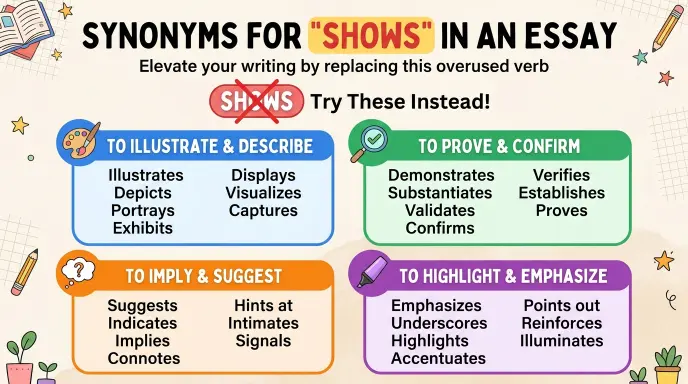
Learning synonyms for shows in an essay helps you express ideas in fresh and clear ways. Words like demonstrates, reveals, illustrates, and indicates can make your writing stronger. Each word has a slightly different meaning, so choosing the right one matters.
English learners and content writers can use synonyms to build their vocabulary, improve sentence flow, and avoid repetition. This guide explains the meaning of “shows,” its history, pronunciation, and 30 useful synonyms with simple examples. You will also learn how to choose the best word for different types of essays.
Meaning of Synonyms for Shows in an Essay
Definition
Shows (Verb): Shows means to make something visible, clear, or known. It can also mean to explain an idea, present information, or prove something through facts or examples.
In an essay, “shows” often helps writers explain what evidence, facts, or examples tell the reader.
Examples
- The study shows that exercise improves health.
- This example shows the value of teamwork.
Connotative Meaning
Connotation: The feeling or idea that a word creates beyond its basic meaning.
- Positive tone: Shows can suggest clarity, proof, or helpful information.
- Negative tone: It may suggest a lack of depth when repeated too often in an essay.
- Neutral tone: It can simply present a fact, idea, or piece of information.
Etymology
The word “show” has a long history in the English language.
- Old English (450–1100): The word came from Old English scēawian, which meant to look at, see, or examine.
- Middle English (1100–1500): The word developed into forms such as shewen and showen. It began to mean presenting something for others to see.
- Modern English (1500–Present): The spelling “show” became common. Today, it means to display, explain, reveal, or prove something.
Pronunciation (IPA)
- IPA: /ʃoʊz/
- Syllables: Shows (one syllable)
Affixation Pattern of Shows
- Root: Show
- Prefix: None
- Suffix: -s, used for the third-person singular present tense
Word Formations
- Show (Verb): To make something clear or visible.
- Shows (Verb): Present-tense form used with he, she, or it.
- Showed (Verb): Simple past tense of show.
- Shown (Verb): Past participle of show.
- Showing (Verb): Present participle of show.
- Show (Noun): A performance or presentation.
- Shower (Noun): A person or thing that shows something, though this form has other common meanings.
- Showcase (Verb/Noun): To present something in an impressive way; a display of something.
30 Synonyms for Shows in an Essay With Meaning & Examples
These alternatives can help you make your essay more precise and engaging. Choose a word based on what your sentence needs to express.
1. Demonstrates (Verb)
Meaning: To make something clear through facts, examples, or actions.
Examples:
- The study demonstrates the benefits of regular exercise.
- This result demonstrates the need for better planning.
2. Reveals (Verb)
Meaning: To make something known that was hidden or not clear before.
Examples:
- The report reveals a major problem in the system.
- The data reveals a change in public opinion.
3. Illustrates (Verb)
Meaning: To explain an idea with an example or picture.
Examples:
- This story illustrates the power of kindness.
- The chart illustrates the rise in online learning.
4. Indicates (Verb)
Meaning: To suggest or point out that something is true.
Examples:
- The results indicate a link between sleep and health.
- This evidence indicates that the plan may work.
5. Suggests (Verb)
Meaning: To give an idea or sign that something may be true.
Examples:
- The study suggests that reading improves memory.
- This example suggests a need for change.
6. Highlights (Verb)
Meaning: To draw attention to an important point.
Examples:
- The article highlights the effects of air pollution.
- This example highlights the value of education.
7. Displays (Verb)
Meaning: To present or make something visible.
Examples:
- The graph displays changes in temperature.
- The report displays the results of the survey.
8. Presents (Verb)
Meaning: To give information or an idea for others to consider.
Examples:
- The essay presents a clear argument.
- This chapter presents facts about climate change.
9. Depicts (Verb)
Meaning: To describe or represent something through words or images.
Examples:
- The novel depicts life in a small town.
- The painting depicts the beauty of nature.
10. Portrays (Verb)
Meaning: To describe or show someone or something in a certain way.
Examples:
- The story portrays the struggles of young workers.
- The film portrays the effects of poverty.
11. Proves (Verb)
Meaning: To show that something is true through strong evidence.
Examples:
- The experiment proves that the method works.
- These facts prove the value of clean energy.
12. Confirms (Verb)
Meaning: To show that something believed or suspected is true.
Examples:
- The results confirm the earlier findings.
- This report confirms the need for more research.
13. Establishes (Verb)
Meaning: To show or prove something clearly through evidence.
Examples:
- The study establishes a link between diet and health.
- The evidence establishes the main cause of the problem.
14. Demonstrates the Importance of (Verb Phrase)
Meaning: To make the value or need for something clear.
Examples:
- The report demonstrates the importance of clean water.
- This example demonstrates the importance of teamwork.
15. Emphasizes (Verb)
Meaning: To give special importance or attention to an idea.
Examples:
- The essay emphasizes the need for better schools.
- This point emphasizes the value of hard work.
16. Underscores (Verb)
Meaning: To show that something is very important.
Examples:
- The data underscores the need for action.
- This result underscores the value of education.
17. Expresses (Verb)
Meaning: To communicate a thought, feeling, or idea.
Examples:
- The poem expresses the pain of losing a loved one.
- The writer expresses concern about climate change.
18. Communicates (Verb)
Meaning: To share information, thoughts, or feelings.
Examples:
- The article communicates a clear message.
- This example communicates the value of honesty.
19. Explains (Verb)
Meaning: To make an idea or fact easy to understand.
Examples:
- The report explains how pollution affects health.
- This paragraph explains the cause of the problem.
20. Describes (Verb)
Meaning: To give details about a person, place, thing, or event.
Examples:
- The essay describes the effects of social media.
- This passage describes life in the countryside.
21. Reflects (Verb)
Meaning: To represent or express a quality, feeling, or situation.
Examples:
- The survey reflects public opinion.
- The story reflects the challenges of modern life.
22. Signifies (Verb)
Meaning: To represent or mean something important.
Examples:
- This change signifies progress in education.
- The result signifies a major improvement.
23. Demonstrates Clearly (Verb Phrase)
Meaning: To make an idea easy to understand through evidence.
Examples:
- The experiment demonstrates clearly how the process works.
- The results demonstrate clearly the need for reform.
24. Exemplifies (Verb)
Meaning: To serve as a clear example of something.
Examples:
- Her actions exemplify true leadership.
- This case exemplifies the dangers of poor planning.
25. Evokes (Verb)
Meaning: To bring a feeling, memory, or image to mind.
Examples:
- The poem evokes feelings of hope.
- The story evokes memories of childhood.
26. Exposes (Verb)
Meaning: To reveal something hidden, harmful, or unknown.
Examples:
- The investigation exposes serious flaws in the system.
- The report exposes the dangers of unsafe working conditions.
27. Makes Clear (Verb Phrase)
Meaning: To help someone understand something easily.
Examples:
- This example makes clear why teamwork matters.
- The evidence makes clear the need for change.
28. Points To (Verb Phrase)
Meaning: To suggest or direct attention toward something.
Examples:
- The evidence points to a serious problem.
- These findings point to a need for further study.
29. Demonstrates Effectively (Verb Phrase)
Meaning: To show an idea in a clear and useful way.
Examples:
- The writer demonstrates effectively the value of education.
- This case demonstrates effectively how teamwork succeeds.
30. Supports (Verb)
Meaning: To provide evidence that helps prove or strengthen an idea.
Examples:
- The research supports the main argument.
- These facts support the claim that exercise improves health.
Prototype Meaning
The most typical meaning of “shows” is to make something clear or visible to another person. In an essay, readers usually imagine a writer presenting facts, examples, or evidence to explain an idea. For example, a sentence such as “The study shows that sleep improves memory” tells readers what the evidence suggests. The word is common because it is simple and works in many situations. However, stronger alternatives can explain whether the evidence proves, suggests, reveals, or highlights something.
Prototype Categorization
The 30 synonyms can be grouped into useful semantic categories. This helps writers choose words that match their exact meaning instead of using the same word again and again.
– Proof and Evidence: Demonstrates, proves, confirms, establishes, supports. These words work well when discussing research, facts, and strong evidence.
– Discovery and Revelation: Reveals, exposes, indicates, suggests, points to. These words help explain findings or information that was not clear before.
– Explanation and Clarity: Illustrates, explains, describes, makes clear, demonstrates clearly. These words help readers understand complex ideas.
– Attention and Importance: Highlights, emphasizes, underscores, demonstrates the importance of. These words draw attention to key points in an essay.
– Presentation and Representation: Displays, presents, depicts, portrays, reflects. These words describe how information, people, or events are presented.
– Communication and Expression: Expresses, communicates, signifies, evokes. These words explain how ideas, feelings, or messages are shared.
– Examples and Support: Exemplifies, demonstrates effectively, supports. These words help writers connect examples and evidence to their main argument.
Understanding these categories helps you select the right synonym for your essay. A research paper may need “demonstrates” or “establishes,” while a literary essay may work better with “portrays” or “depicts.”
Antonyms of Shows
Antonyms are words with opposite or contrasting meanings. The best antonym depends on how “shows” is used in a sentence.
1. Hides (Verb)
Meaning: To keep something out of sight or prevent others from knowing it.
2. Conceals (Verb)
Meaning: To keep something secret or not allow it to be seen.
3. Masks (Verb)
Meaning: To cover or hide the true nature of something.
4. Obscures (Verb)
Meaning: To make something difficult to see or understand.
5. Withholds (Verb)
Meaning: To keep information or something else from being shared.
6. Disguises (Verb)
Meaning: To change the appearance of something to hide its true identity.
Short Questions and Answers
What does “shows” mean?
“Shows” means to make something clear, visible, or known. In an essay, it often introduces evidence or examples that explain an idea.
When should “shows” be used?
Use “shows” when you want to explain what facts, examples, or evidence tell the reader. It is useful in both formal and informal writing.
Is “shows” positive or negative?
“Shows” is usually neutral. Its tone depends on the information being presented. It can describe positive results, negative effects, or simple facts.
How is “shows” different from similar words?
“Shows” is a general word. “Demonstrates” often suggests evidence, “reveals” suggests new information, and “highlights” draws attention to an important point.
Conclusion
Learning synonyms for shows in an essay can make your writing clearer, stronger, and more interesting. Words like “demonstrates,” “reveals,” “illustrates,” and “highlights” help you explain ideas in different ways. They also help you avoid repeating the same word in every paragraph.
Each synonym has its own meaning and use. Some words are best for research and evidence, while others work well for stories, examples, or opinions. Choosing the right word helps readers understand your message.
The best way to improve your vocabulary is to practice every day. Read English articles, notice how writers use different words, and try adding new synonyms to your own sentences. With regular practice, you can build confidence and become a better English writer and speaker.

Jonathan writes simple, easy-to-understand English vocabulary guides, word meanings and synonyms at SimilGrid.