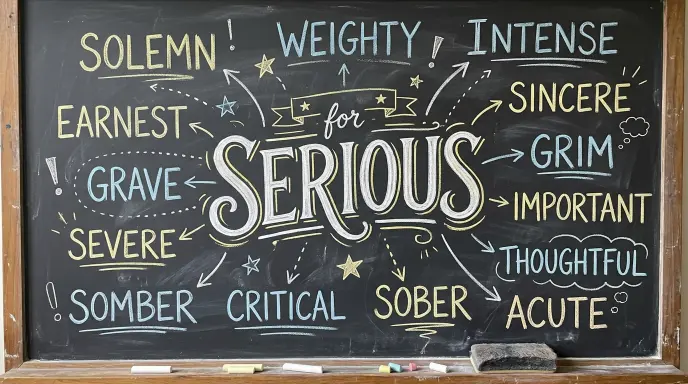
Serious is a common English word that describes something important, thoughtful, or not meant for fun. Imagine a teacher telling students to be serious before an important test. The teacher wants them to focus and do their best.
People use the word serious in daily talks, school, work, and writing. It can describe a person, a problem, a decision, or a situation. However, using the same word again and again can make writing sound dull.
Learning synonyms for serious helps English learners build a stronger vocabulary. It also helps content writers make their work clear, natural, and interesting. Different synonyms can express different feelings, levels of importance, and types of behavior.
This article explains the meaning of serious, its pronunciation, history, word forms, and 30 useful synonyms with simple meanings and examples. You will also learn how to choose the right word for each situation.
Meaning of Serious
Definition
Serious (Adjective): Something important, requiring attention, or showing deep thought. It can also describe a person who does not joke or laugh much.
Examples
- We have a serious problem that needs a quick solution.
- My brother is serious about his studies.
Connotative Meaning
Connotation: The feeling or idea that a word brings to mind beyond its basic meaning.
- Positive tone: Shows care, focus, honesty, or strong purpose.
- Negative tone: May suggest worry, danger, strictness, or a lack of fun.
- Neutral tone: Simply describes something important or needing attention.
Etymology
The word serious comes from the Latin word serius, meaning “weighty,” “important,” or “grave.”
- Old English (450–1100): The modern word serious was not commonly used in Old English. Words such as sār and hefig could express ideas of sorrow or heaviness.
- Middle English (1100–1500): Serious entered English through Old French serieux, which came from Latin serius.
- Modern English (1500–Present): Serious became widely used to describe important matters, deep thought, and people who behave in a thoughtful or formal way.
Pronunciation (IPA)
- IPA: /ˈsɪəriəs/ (British English), /ˈsɪriəs/ (American English)
- Syllables: se-ri-ous
- Stress: First syllable
Affixation Pattern of Serious
- Root: Serious
- Prefix: None
- Suffix: -ous, which forms adjectives
- Word formations:
- Serious — Adjective: important or thoughtful
- Seriously — Adverb: in an important or thoughtful way
- Seriousness — Noun: the quality of being serious
- Unserious — Adjective: not serious or not important
- Unseriously — Adverb: in a way that is not serious
30 Synonyms of Serious With Meaning & Examples
These 30 synonyms can replace serious in different situations. Some describe important matters, while others describe a person’s behavior, feelings, or attitude.
1. Important (Adjective)
Meaning: Having great value or needing attention.
Examples:
- This is an important meeting.
- She made an important decision today.
2. Significant (Adjective)
Meaning: Having a special meaning or great effect.
Examples:
- The team made significant progress.
- This is a significant change in our plans.
3. Grave (Adjective)
Meaning: Very serious, often because something bad may happen.
Examples:
- The doctor shared the grave news.
- We face a grave danger.
4. Critical (Adjective)
Meaning: Very important or needing quick attention.
Examples:
- The patient is in critical condition.
- This is a critical moment for our team.
5. Urgent (Adjective)
Meaning: Needing immediate action or attention.
Examples:
- We have an urgent request.
- The matter needs urgent care.
6. Severe (Adjective)
Meaning: Very serious, harsh, or intense.
Examples:
- The storm caused severe damage.
- He has a severe injury.
7. Sincere (Adjective)
Meaning: Honest and showing real feelings.
Examples:
- She gave a sincere apology.
- He made a sincere promise to help.
8. Solemn (Adjective)
Meaning: Showing deep respect or a serious mood.
Examples:
- The room became solemn during the speech.
- They held a solemn ceremony.
9. Earnest (Adjective)
Meaning: Showing honest and strong feelings or purpose.
Examples:
- He made an earnest request.
- She gave an earnest effort to improve.
10. Thoughtful (Adjective)
Meaning: Showing careful thought or concern for others.
Examples:
- She gave a thoughtful answer.
- He made a thoughtful choice.
11. Focused (Adjective)
Meaning: Giving full attention to a task or goal.
Examples:
- The students stayed focused during class.
- She is focused on her future.
12. Attentive (Adjective)
Meaning: Paying close attention to someone or something.
Examples:
- The nurse was attentive to the patient.
- He remained attentive during the lesson.
13. Dedicated (Adjective)
Meaning: Giving time and effort to a goal or duty.
Examples:
- She is a dedicated teacher.
- He is dedicated to his work.
14. Committed (Adjective)
Meaning: Willing to give time and effort to something.
Examples:
- They are committed to helping others.
- He is committed to his studies.
15. Determined (Adjective)
Meaning: Having a strong desire to reach a goal.
Examples:
- She is determined to win.
- He remained determined after failure.
16. Resolute (Adjective)
Meaning: Firm and strong in purpose or belief.
Examples:
- The leader remained resolute.
- She was resolute in her decision.
17. Formal (Adjective)
Meaning: Following rules or a proper style of behavior.
Examples:
- The meeting had a formal tone.
- He wore formal clothes to the event.
18. Professional (Adjective)
Meaning: Showing skill, care, and proper behavior at work.
Examples:
- She gave a professional response.
- He handled the issue in a professional way.
19. Businesslike (Adjective)
Meaning: Practical, efficient, and focused on work.
Examples:
- He took a businesslike approach.
- Their discussion was short and businesslike.
20. Grave-minded (Adjective)
Meaning: Having a thoughtful or serious attitude.
Examples:
- The grave-minded judge listened carefully.
- He seemed grave-minded during the talk.
21. Concerned (Adjective)
Meaning: Worried or showing care about a problem.
Examples:
- She was concerned about her health.
- Parents are concerned about school safety.
22. Worried (Adjective)
Meaning: Feeling nervous or troubled about something.
Examples:
- He looked worried after the call.
- I am worried about the exam.
23. Anxious (Adjective)
Meaning: Feeling uneasy or nervous about something.
Examples:
- She felt anxious before the interview.
- He was anxious about the results.
24. Troubled (Adjective)
Meaning: Feeling worried or facing problems.
Examples:
- He looked troubled by the news.
- The troubled family needed help.
25. Intense (Adjective)
Meaning: Very strong or deeply felt.
Examples:
- They had an intense discussion.
- She felt intense pressure before the test.
26. Deep (Adjective)
Meaning: Showing strong thought, feeling, or meaning.
Examples:
- We had a deep conversation.
- His words showed deep concern.
27. Weighty (Adjective)
Meaning: Important and deserving careful thought.
Examples:
- The judge faced a weighty decision.
- They discussed a weighty issue.
28. Momentous (Adjective)
Meaning: Very important because it may change the future.
Examples:
- It was a momentous day for the country.
- She made a momentous choice.
29. Consequential (Adjective)
Meaning: Having important results or effects.
Examples:
- This is a consequential decision.
- Their actions had consequential effects.
30. Stern (Adjective)
Meaning: Strict and firm in behavior or manner.
Examples:
- The teacher gave a stern warning.
- Her father used a stern voice.
Prototype Meaning
The prototype meaning of serious is something important that needs attention, care, or thought. When people hear this word, they often imagine a person dealing with an important matter, a doctor discussing a health problem, or a student preparing for a major exam.
The word can also describe someone who does not joke often or who behaves in a thoughtful way. Its main idea is that something deserves attention and should not be treated as a joke.
Prototype Categorization
The 30 synonyms can be grouped into meaningful categories. These groups help writers choose words that match the exact meaning they want to express.
- Importance and value: Important, significant, weighty, momentous, consequential. These words describe matters that have great value or may affect the future.
- Danger and urgency: Grave, critical, urgent, severe. These words are useful when something is dangerous, difficult, or needs quick action.
- Thought and attention: Thoughtful, focused, attentive, deep. These words describe careful thinking and strong attention.
- Honesty and purpose: Sincere, earnest, dedicated, committed, determined, resolute. These words show strong feelings, effort, or purpose.
- Formal behavior: Solemn, formal, professional, businesslike, stern. These words describe proper, strict, or respectful behavior.
- Worry and concern: Concerned, worried, anxious, troubled. These words describe fear, stress, or care about a problem.
- Strong feelings or ideas: Intense. This word describes something powerful or deeply felt.
- Thoughtful attitude: Grave-minded. This word describes a person who seems deeply thoughtful or serious.
Choosing the right category helps writers avoid repetition and express their ideas more clearly.
Antonyms of Serious
Antonyms are words that have opposite meanings.
1. Funny (Adjective)
Meaning: Making people laugh or feel happy.
2. Humorous (Adjective)
Meaning: Showing humor or making people laugh.
3. Playful (Adjective)
Meaning: Full of fun and a desire to play.
4. Carefree (Adjective)
Meaning: Free from worry or stress.
5. Casual (Adjective)
Meaning: Relaxed and not formal.
6. Lighthearted (Adjective)
Meaning: Happy and free from serious worries.
7. Silly (Adjective)
Meaning: Showing a lack of serious thought or good sense.
8. Trivial (Adjective)
Meaning: Not important or worth much attention.
9. Minor (Adjective)
Meaning: Small or less important.
10. Unimportant (Adjective)
Meaning: Not having much value or importance.
Short Questions and Answers
What does serious mean?
Serious means important, thoughtful, or needing attention. It can also describe a person who does not joke much.
When should serious be used?
Use serious when talking about important matters, deep feelings, difficult situations, or people who behave in a thoughtful way.
Is serious positive or negative?
Serious can be positive, negative, or neutral. It can show focus and care, but it can also describe danger, worry, or strict behavior.
How is serious different from similar words?
Serious is a general word for something important or thoughtful. Grave often suggests danger, sincere shows honesty, urgent means immediate action is needed, and solemn describes a respectful or serious mood.
Conclusion
Learning synonyms for serious helps you build a stronger English vocabulary. Each synonym has its own meaning and use. Words such as important, critical, sincere, and thoughtful can make your writing clearer and more interesting.
Using different words also helps you avoid repetition in articles, essays, emails, and daily conversations. It allows you to express your thoughts in a more natural way.
For English learners, understanding synonyms is a useful step toward better speaking and writing. You can practice by reading examples, writing your own sentences, and using new words in daily talks.
Start with a few synonyms each day. With regular practice, you will gain more confidence and become a better English speaker and writer.

Jonathan writes simple, easy-to-understand English vocabulary guides, word meanings and synonyms at SimilGrid.