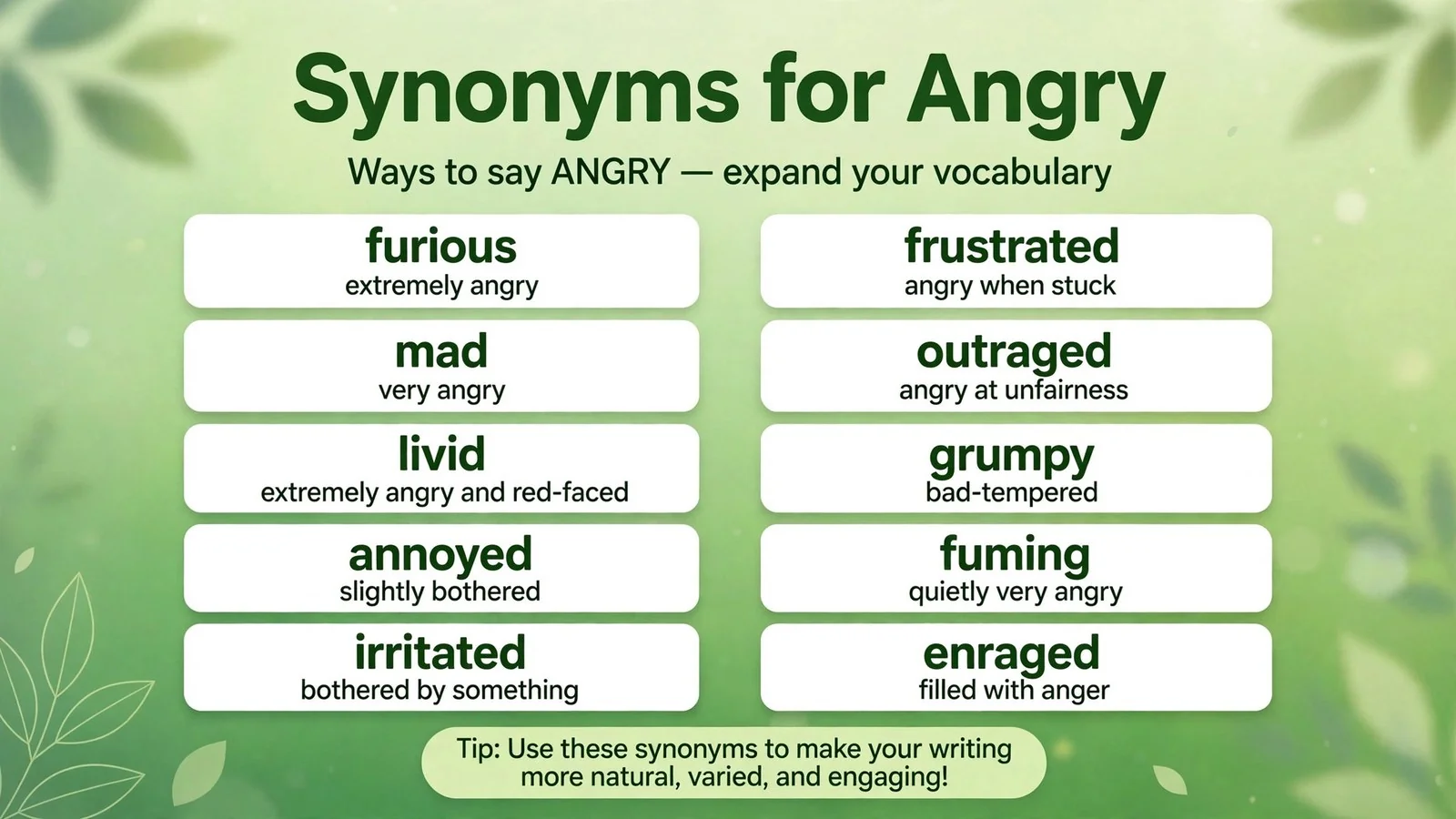
Have you ever felt your face turn red when someone cut in front of you in line? That hot feeling is anger, and we all feel it sometimes. Being angry means feeling strong displeasure about something unfair or wrong. Everyone gets angry — kids, parents, teachers, bosses. But saying just “angry” every time sounds boring and flat. Learning synonyms for angry helps students write better essays, bloggers create richer posts, and daily English users express feelings more clearly. Instead of repeating one word, you can pick the exact word that fits your mood, from mildly annoyed to truly furious. These synonyms for angry will make your English sound natural and precise in any situation.
Furious
Meaning: Extremely angry, almost out of control.
Examples:
- He was furious when he saw the dent in his new car.
- The coach was furious about the team’s lazy performance.
Mad
Meaning: Very angry or annoyed about something.
Examples:
- She was mad at her brother for breaking her phone.
- Don’t get mad; it was just an honest mistake.
Irate
Meaning: Very angry, often about bad service or treatment.
Examples:
- The irate customer demanded to speak to the manager.
- He became irate after waiting two hours for his food.
Enraged
Meaning: Filled with violent anger.
Examples:
- The enraged bull charged at the fence.
- She was enraged by the false news about her family.
Livid
Meaning: Extremely angry, often shown on the face.
Examples:
- His face turned livid when he heard the lie.
- Mom was livid after seeing my bad grades.
Fuming
Meaning: Quietly very angry, like steam building up inside.
Examples:
- He was fuming in the meeting but said nothing.
- She kept fuming about the rude email all day.
Annoyed
Meaning: Slightly angry or bothered by something small.
Examples:
- I was annoyed by the loud music next door.
- He gets annoyed when people are late.
Irritated
Meaning: Made angry by something repeated or unpleasant.
Examples:
- The buzzing fly irritated everyone in the room.
- She felt irritated by his constant questions.
Frustrated
Meaning: Angry because something is not working as expected.
Examples:
- He felt frustrated with the slow internet.
- The team was frustrated after losing three games in a row.
Outraged
Meaning: Very angry about something unfair or shocking.
Examples:
- People were outraged by the rise in prices.
- She was outraged when she saw the unfair decision.
Incensed
Meaning: Very angry, often about an insult or injustice.
Examples:
- The workers were incensed by the sudden pay cut.
- He was incensed at the rude comment.
Infuriated
Meaning: Made extremely angry.
Examples:
- The delay infuriated the passengers at the airport.
- His careless reply infuriated his boss.
Wrathful
Meaning: Full of deep, powerful anger.
Examples:
- The wrathful king punished the traitors.
- She gave him a wrathful look across the table.
Heated
Meaning: Angry and excited during an argument.
Examples:
- Their heated debate lasted for an hour.
- The discussion became heated very quickly.
Cross
Meaning: Mildly angry or annoyed with someone.
Examples:
- Dad was cross because I forgot his birthday.
- She sounded cross on the phone this morning.
Grumpy
Meaning: Bad-tempered and easily annoyed.
Examples:
- He is always grumpy before his morning coffee.
- The grumpy neighbor shouted at the kids.
Cranky
Meaning: Irritable and hard to please at the moment.
Examples:
- The baby gets cranky when she is tired.
- Lack of sleep made him cranky all day.
Testy
Meaning: Easily angered, quick to snap at others.
Examples:
- The tired driver grew testy in the traffic jam.
- She gave a testy reply to the reporter.
Exasperated
Meaning: Very frustrated after dealing with something too long.
Examples:
- The teacher was exasperated by the noisy class.
- He sighed in an exasperated way and walked out.
Aggravated
Meaning: Made more angry or worse by something.
Examples:
- The long wait aggravated the tired travelers.
- His rude tone only aggravated the situation.
Provoked
Meaning: Made angry by someone’s deliberate actions.
Examples:
- She felt provoked by his unfair blame.
- The dog was provoked by the stranger’s stick.
Offended
Meaning: Hurt and angry because of disrespect.
Examples:
- He was offended by the joke about his accent.
- She felt offended when they ignored her idea.
Resentful
Meaning: Angry because of unfair treatment over time.
Examples:
- He grew resentful of his boss taking credit for his work.
- She felt resentful toward her friend for lying.
Bitter
Meaning: Angry and hurt about past unfairness.
Examples:
- He still feels bitter about losing the contest unfairly.
- Her bitter words showed years of pain.
Hostile
Meaning: Openly angry and unfriendly toward someone.
Examples:
- The crowd turned hostile after the bad call.
- His hostile tone scared the new employee.
Vicious
Meaning: Angry in a cruel and harmful way.
Examples:
- The vicious dog barked at every stranger.
- She wrote a vicious reply full of hate.
Ferocious
Meaning: Wildly angry and intense.
Examples:
- The ferocious storm destroyed the small huts.
- He gave a ferocious roar when his team scored.
Wild
Meaning: Angry and out of control.
Examples:
- The wild crowd broke through the barriers.
- She went wild when she heard the good news was false.
Stormy
Meaning: Full of anger, like a rough storm.
Examples:
- They had a stormy argument last night.
- His stormy mood ruined the whole trip.
Seething
Meaning: Boiling with anger inside while staying quiet.
Examples:
- She was seething after the unfair review.
- He sat seething in the corner of the room.
Conclusion
Learning these words helps you describe anger exactly the way you feel it. Good vocabulary makes your writing stronger, your blogging richer, and your speaking clearer. Try using these new words in your emails, essays, and daily conversations. The more you practice, the more natural they will feel. Keep learning, and your English will keep getting better every day.

Jonathan writes simple, easy-to-understand English vocabulary guides, word meanings and synonyms at SimilGrid.